

Cleared for Combat: The Journey from AI Student Pilot to Top Gun Fighter
Top Executive Insights
- Move from AI pilots to governed scale
Quick Wins
- Pilot to scale failure rate
- Workflow ownership gaps
- Governance readiness indicators
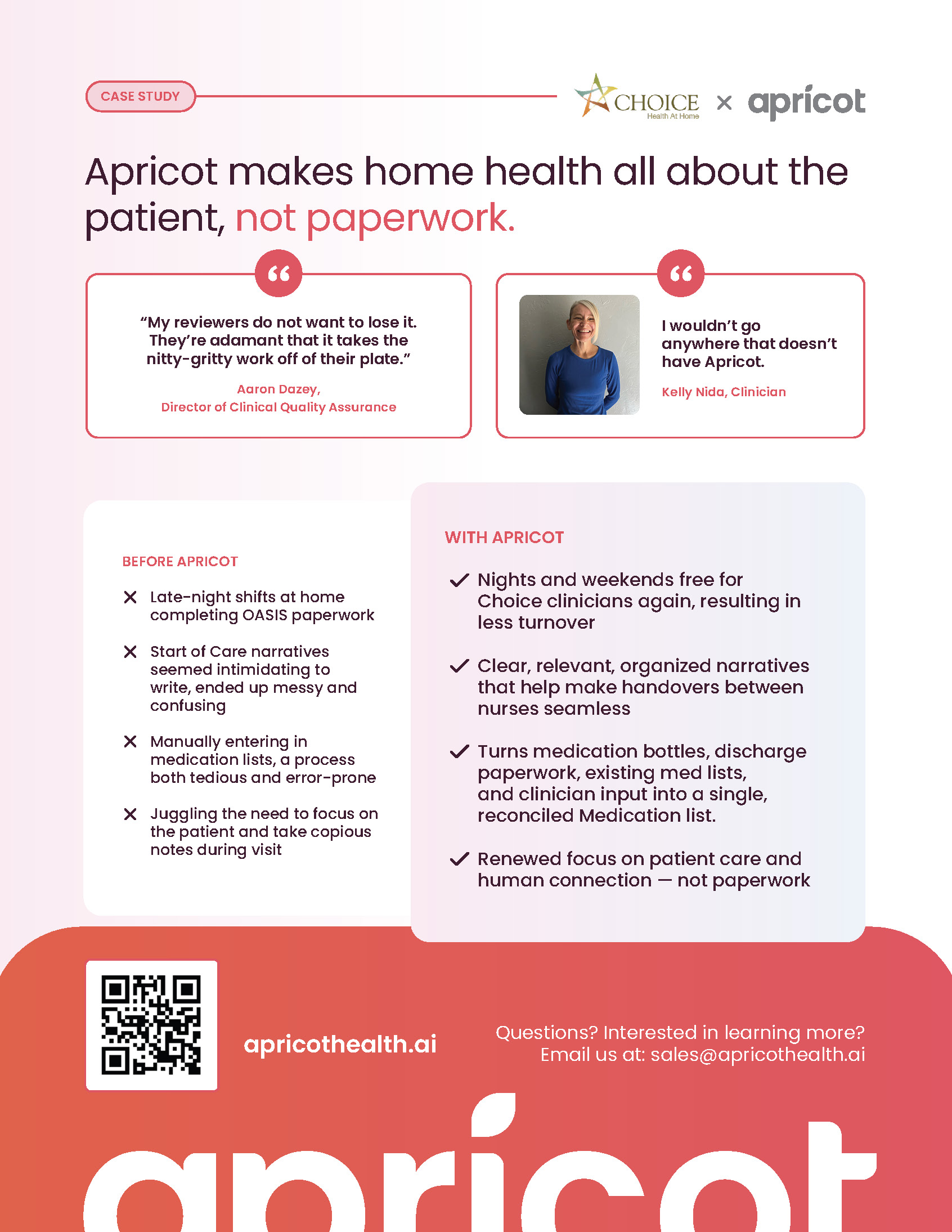
Apricot makes home health all about the patient, not paperwork.
Explore service-line insights with top actions, executive insights, and practical guidance that you can download and use immediately.

Audits do not begin with individual charts—they begin with patterns. When admissions are driven by pressure instead of clinical appropriateness, Start of Care assessments prioritize speed over accuracy, or documentation tells a task list instead of a patient story, risk quietly accumulates. This insight helps leaders shift compliance from reactive chart review to proactive team thinking, using consistent prompts that protect patients, staff, and organizational defensibility.
Embed short, structured compliance huddles into daily and weekly workflows to surface risk early and reinforce disciplined clinical decision-making.
Many organizations treat QAPI as a reporting obligation rather than a leadership operating system. When QAPI focuses on isolated issues instead of patterns, risks surface too late—during audits, surveys, or payment denials. This insight reframes QAPI as a continuous, proactive oversight function that connects governance, data, documentation, workforce behavior, and technology into a unified early-warning system leaders can actually act on.
Turning QAPI into an Early Warning Operating System.
Many AI missteps occur not because the technology is flawed, but because instructions are unclear, incomplete, or lack guardrails. When prompts fail to define role, intent, constraints, or output expectations, AI responses can introduce risk, noise, or rework. This insight reframes AI as a support resource that must be directed with the same clarity as any team member—helping organizations reduce documentation burden, maintain regulatory confidence, and trust the outputs they receive.
Standardize how AI is prompted across the organization to ensure outputs are clear, compliant, clinically appropriate, and aligned with professional judgment.
Growth often feels positive until its side effects emerge—workarounds increase, staff strain rises, documentation slips, and margins tighten. Boards and executives frequently see these signals too late, after quality or compliance is already compromised. This insight provides a concise, trend-based dashboard that helps leaders assess whether growth is strengthening the organization or quietly increasing enterprise risk—so course correction happens early, not after damage is done.
Monitor growth signals before risk compounds.
Audits do not begin with individual charts—they begin with patterns. When admissions are driven by pressure instead of clinical appropriateness, Start of Care assessments prioritize speed over accuracy, or documentation tells a task list instead of a patient story, risk quietly accumulates. This insight helps leaders shift compliance from reactive chart review to proactive team thinking, using consistent prompts that protect patients, staff, and organizational defensibility.
Embed short, structured compliance huddles into daily and weekly workflows to surface risk early and reinforce disciplined clinical decision-making.
Many organizations treat QAPI as a reporting obligation rather than a leadership operating system. When QAPI focuses on isolated issues instead of patterns, risks surface too late—during audits, surveys, or payment denials. This insight reframes QAPI as a continuous, proactive oversight function that connects governance, data, documentation, workforce behavior, and technology into a unified early-warning system leaders can actually act on.
Turning QAPI into an Early Warning Operating System.
Many AI missteps occur not because the technology is flawed, but because instructions are unclear, incomplete, or lack guardrails. When prompts fail to define role, intent, constraints, or output expectations, AI responses can introduce risk, noise, or rework. This insight reframes AI as a support resource that must be directed with the same clarity as any team member—helping organizations reduce documentation burden, maintain regulatory confidence, and trust the outputs they receive.
Standardize how AI is prompted across the organization to ensure outputs are clear, compliant, clinically appropriate, and aligned with professional judgment.
Growth often feels positive until its side effects emerge—workarounds increase, staff strain rises, documentation slips, and margins tighten. Boards and executives frequently see these signals too late, after quality or compliance is already compromised. This insight provides a concise, trend-based dashboard that helps leaders assess whether growth is strengthening the organization or quietly increasing enterprise risk—so course correction happens early, not after damage is done.
Monitor growth signals before risk compounds.


Many organizations manage compliance reactively—responding to audits, denials, or survey findings after risk has already materialized. As complexity increases across EVV, staffing, documentation, and billing, leaders need real-time visibility into the indicators most likely to trigger exposure. This insight introduces a practical, executive-visible Compliance Control Tower that consolidates high-risk metrics, enforces accountability, and turns compliance from firefighting into prevention.
Centralize compliance risk for proactive prevention.
Age-Friendly Care efforts often stall after training—treated as a clinical initiative rather than an operational standard. When the 4Ms live only in care plans or education materials, their impact fades quickly. This insight helps leaders operationalize the 4Ms across intake, care planning, caregiver workflows, and quality review—so "What Matters," Medication, Mentation, and Mobility consistently shape decisions, actions, and outcomes every day.
Hardwire the 4Ms into daily care delivery.
Many AI initiatives fail because organizations try to do too much at once—or pursue AI without a clear decision it is meant to improve. This insight helps leaders avoid "AI for AI's sake" by starting with one high-value predictive use case that directly changes behavior and outcomes. By clearly defining how leaders act on predictive insight—and setting guardrails that preserve human judgment—organizations can build confidence, prove value, and scale responsibly.
Focus AI on one decision, then expand.
Many organizations pursue growth by focusing on outcomes—revenue, referrals, or census—without aligning the daily behaviors that actually drive results. This often creates silos, inconsistent execution, and unpredictable performance. This insight provides leaders with a practical growth execution system built on lead measures, shared accountability, and weekly visibility—so growth becomes intentional, repeatable, and owned across the organization, not just by sales or leadership alone.
Discipline growth through shared leading-indicator accountability.
Many organizations manage compliance reactively—responding to audits, denials, or survey findings after risk has already materialized. As complexity increases across EVV, staffing, documentation, and billing, leaders need real-time visibility into the indicators most likely to trigger exposure. This insight introduces a practical, executive-visible Compliance Control Tower that consolidates high-risk metrics, enforces accountability, and turns compliance from firefighting into prevention.
Centralize compliance risk for proactive prevention.
Age-Friendly Care efforts often stall after training—treated as a clinical initiative rather than an operational standard. When the 4Ms live only in care plans or education materials, their impact fades quickly. This insight helps leaders operationalize the 4Ms across intake, care planning, caregiver workflows, and quality review—so "What Matters," Medication, Mentation, and Mobility consistently shape decisions, actions, and outcomes every day.
Hardwire the 4Ms into daily care delivery.
Many AI initiatives fail because organizations try to do too much at once—or pursue AI without a clear decision it is meant to improve. This insight helps leaders avoid "AI for AI's sake" by starting with one high-value predictive use case that directly changes behavior and outcomes. By clearly defining how leaders act on predictive insight—and setting guardrails that preserve human judgment—organizations can build confidence, prove value, and scale responsibly.
Focus AI on one decision, then expand.
Many organizations pursue growth by focusing on outcomes—revenue, referrals, or census—without aligning the daily behaviors that actually drive results. This often creates silos, inconsistent execution, and unpredictable performance. This insight provides leaders with a practical growth execution system built on lead measures, shared accountability, and weekly visibility—so growth becomes intentional, repeatable, and owned across the organization, not just by sales or leadership alone.
Discipline growth through shared leading-indicator accountability.
Regulatory and compliance risk in hospice manifests through two interconnected pathways: billing exposure and survey vulnerability. Billing risk accumulates through small inconsistencies across eligibility and documentation, while survey deficiencies reflect systemic operational breakdowns. When these risks are managed in silos, organizations often address symptoms rather than root causes—leaving both revenue and licensure exposed.
Establish unified compliance oversight that connects billing discipline to survey readiness, ensuring daily claims validation and operational rigor reinforce each other.
CAHPS results don't reflect isolated moments—they reflect consistent behaviors families experience across communication, responsiveness, symptom management, emotional support, and respect. Many leaders focus on scores after they're published, without fully understanding how day to day workflows map directly to the questions families are answering. This insight breaks down the Hospice CAHPS survey itself, helping leaders translate survey language into concrete operational and clinical behaviors that drive better experience, stronger ratings, and fewer surprises.
Design care experiences around CAHPS expectations.
Many AI missteps occur not because the technology is flawed, but because instructions are unclear, incomplete, or lack guardrails. When prompts fail to define role, intent, constraints, or output expectations, AI responses can introduce risk, noise, or rework. This insight reframes AI as a support resource that must be directed with the same clarity as any team member—helping organizations reduce documentation burden, maintain regulatory confidence, and trust the outputs they receive.
Standardize how AI is prompted across the organization to ensure outputs are clear, compliant, clinically appropriate, and aligned with professional judgment.
Hospice quality performance is no longer evaluated through a single lens. The Hospice Quality Reporting Program (HQRP) combines CAHPS experience measures, claims-based utilization data, and clinical follow-up metrics—each telling part of the story regulators, payers, and the public are evaluating. Many organizations review these measures in isolation or after results are published. This insight helps leaders understand how HQRP measures work together and how to operationalize them proactively—so quality performance is designed, monitored, and adjusted in real time, not explained after the fact.
Manage quality as a system, not scores.
Regulatory and compliance risk in hospice manifests through two interconnected pathways: billing exposure and survey vulnerability. Billing risk accumulates through small inconsistencies across eligibility and documentation, while survey deficiencies reflect systemic operational breakdowns. When these risks are managed in silos, organizations often address symptoms rather than root causes—leaving both revenue and licensure exposed.
Establish unified compliance oversight that connects billing discipline to survey readiness, ensuring daily claims validation and operational rigor reinforce each other.
CAHPS results don't reflect isolated moments—they reflect consistent behaviors families experience across communication, responsiveness, symptom management, emotional support, and respect. Many leaders focus on scores after they're published, without fully understanding how day to day workflows map directly to the questions families are answering. This insight breaks down the Hospice CAHPS survey itself, helping leaders translate survey language into concrete operational and clinical behaviors that drive better experience, stronger ratings, and fewer surprises.
Design care experiences around CAHPS expectations.
Many AI missteps occur not because the technology is flawed, but because instructions are unclear, incomplete, or lack guardrails. When prompts fail to define role, intent, constraints, or output expectations, AI responses can introduce risk, noise, or rework. This insight reframes AI as a support resource that must be directed with the same clarity as any team member—helping organizations reduce documentation burden, maintain regulatory confidence, and trust the outputs they receive.
Standardize how AI is prompted across the organization to ensure outputs are clear, compliant, clinically appropriate, and aligned with professional judgment.
Hospice quality performance is no longer evaluated through a single lens. The Hospice Quality Reporting Program (HQRP) combines CAHPS experience measures, claims-based utilization data, and clinical follow-up metrics—each telling part of the story regulators, payers, and the public are evaluating. Many organizations review these measures in isolation or after results are published. This insight helps leaders understand how HQRP measures work together and how to operationalize them proactively—so quality performance is designed, monitored, and adjusted in real time, not explained after the fact.
Manage quality as a system, not scores.