

Main content blocks

Presented by

INNOVATION INSIGHTS

TURN AGILE 2026 INTO ACTION ACROSS YOUR ORGANIZATION

Presented by
 

Thank you for attending AGILE 2026. 
We hope you left inspired, informed and ready to apply new ideas across your organization.

The full value of AGILE comes from turning knowledge into action. 
These tools are designed to help you apply strategies from the EDGE workshop and AGILE sessions in a structured, repeatable way.

Navigate by service line to find insights, resources and tools that help align teams, standardize processes and drive measurable results.

Sponsor case study

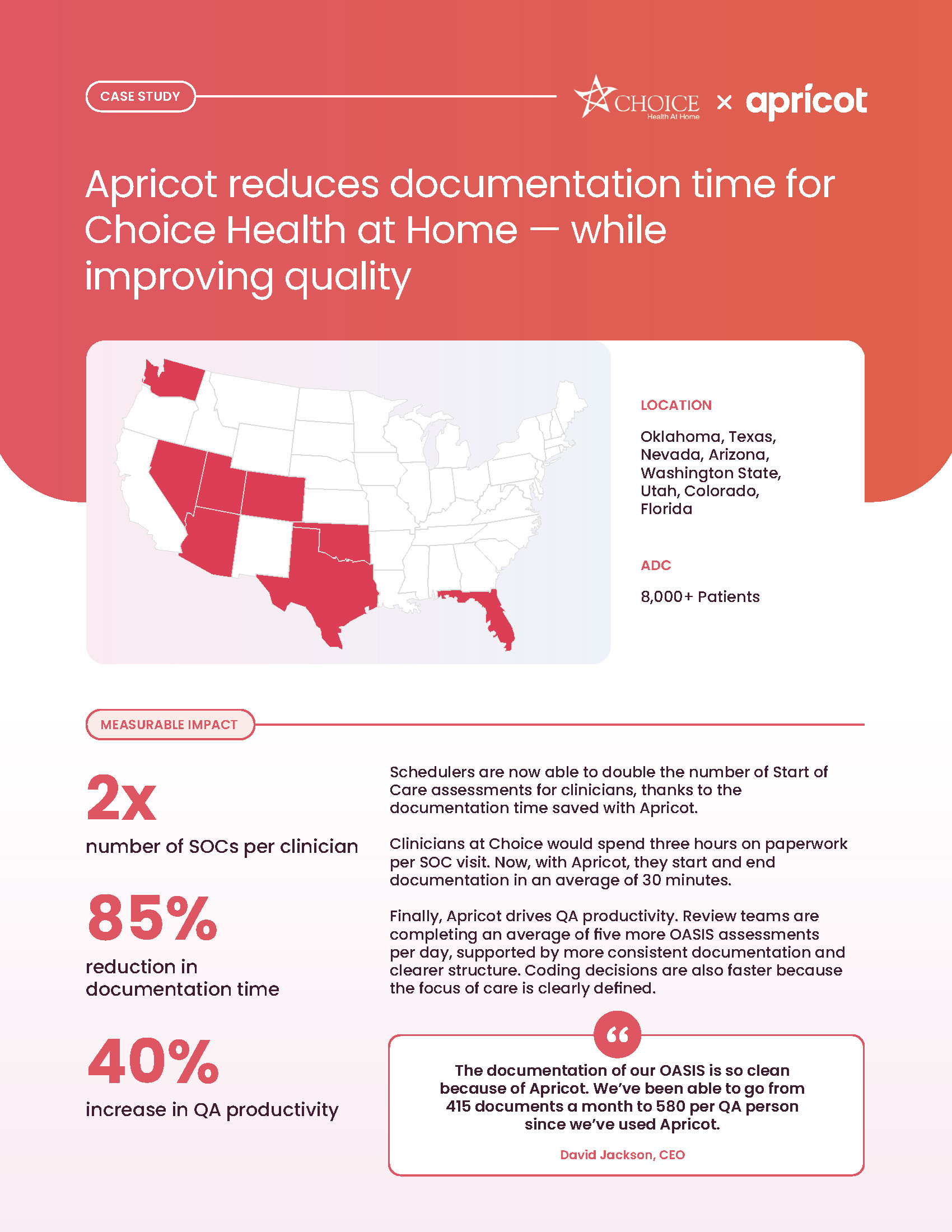
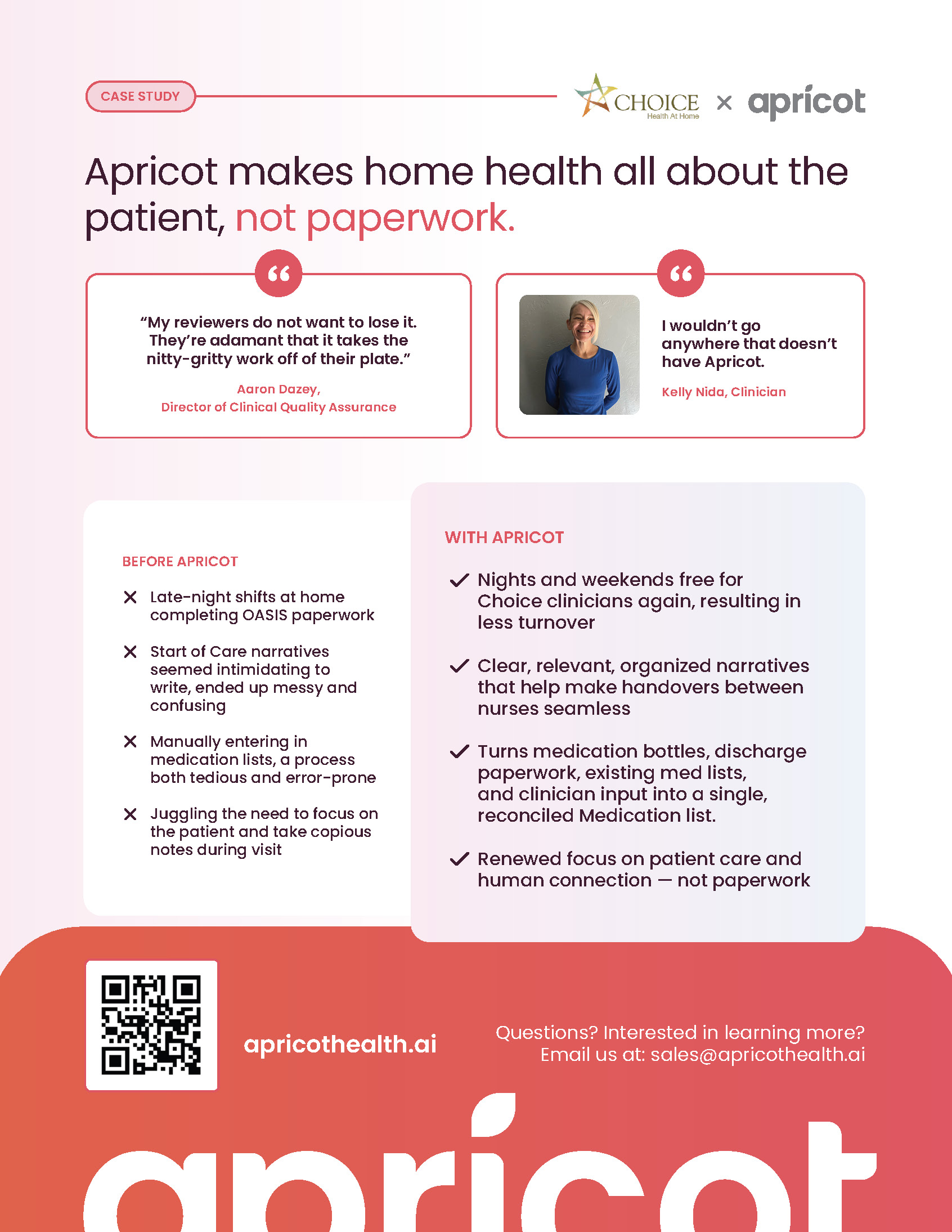
How Apricot Reduced Documentation Time

Case study page 1 preview View full case study →

Apricot makes home health all about the patient, not paperwork.

  • Clear, relevant, organized narratives that help make handovers between nurses seamless
  • Turns medication bottles, discharge paperwork, existing med lists, and clinician input into a single, reconciled Medication list
40%
Increase in QA productivity
30 min
Per Start of Care visit documentation
Learn more about Apricot →

AGILE INNOVATION INSIGHTS TOOLKITS

Explore service-line insights with top actions, executive insights, and practical guidance that you can download and use immediately.

HOME HEALTH

  • EDGE Workshop
  • Home Health Sessions
Open Toolkit

HOMECARE

  • EDGE Workshop
  • Home Care Sessions
Open Toolkit

HOSPICE

  • EDGE Workshop
  • Hospice Sessions
Open Toolkit

EDGE certification

Essential #1 Regulatory and Compliance

Audits do not begin with individual charts—they begin with patterns. When admissions are driven by pressure instead of clinical appropriateness, Start of Care assessments prioritize speed over accuracy, or documentation tells a task list instead of a patient story, risk quietly accumulates. This insight helps leaders shift compliance from reactive chart review to proactive team thinking, using consistent prompts that protect patients, staff, and organizational defensibility.

Executive Action

Embed short, structured compliance huddles into daily and weekly workflows to surface risk early and reinforce disciplined clinical decision-making.

Key Wins
Admission pressure points where saying "yes" creates future clinical or compliance risk
Emerging QA patterns that should be reviewed internally before external scrutiny
Care plan misalignment across disciplines within a single patient chart

Essential #2 Patient Centered Care

Many organizations treat QAPI as a reporting obligation rather than a leadership operating system. When QAPI focuses on isolated issues instead of patterns, risks surface too late—during audits, surveys, or payment denials. This insight reframes QAPI as a continuous, proactive oversight function that connects governance, data, documentation, workforce behavior, and technology into a unified early-warning system leaders can actually act on.

Executive Action

Turning QAPI into an Early Warning Operating System.

Key Wins
Recurring risk patterns masked by one-off issue review (LOS, utilization, eligibility, documentation)
Action execution gaps where findings do not translate into workflow change
Governance breakdowns across accountability, follow through, and sustained improvement

Essential #3 Innovation and AI

Many AI missteps occur not because the technology is flawed, but because instructions are unclear, incomplete, or lack guardrails. When prompts fail to define role, intent, constraints, or output expectations, AI responses can introduce risk, noise, or rework. This insight reframes AI as a support resource that must be directed with the same clarity as any team member—helping organizations reduce documentation burden, maintain regulatory confidence, and trust the outputs they receive.

Executive Action

Standardize how AI is prompted across the organization to ensure outputs are clear, compliant, clinically appropriate, and aligned with professional judgment.

Key Wins
Clear role definition so AI responds from an appropriate clinical, operational, or leadership perspective
Improved output consistency through explicit formatting and length expectations
Reduced rework and risk by embedding constraints that preserve accuracy and compliance

Essential #4 Growth

Growth often feels positive until its side effects emerge—workarounds increase, staff strain rises, documentation slips, and margins tighten. Boards and executives frequently see these signals too late, after quality or compliance is already compromised. This insight provides a concise, trend-based dashboard that helps leaders assess whether growth is strengthening the organization or quietly increasing enterprise risk—so course correction happens early, not after damage is done.

Executive Action

Monitor growth signals before risk compounds.

Key Wins
Growth-driven strain indicators across capacity, staffing, and leadership bandwidth
Early quality and eligibility drift masked by rising volume
Misalignment between growth pace and operational scalability
Essential #1 Regulatory and Compliance

Audits do not begin with individual charts—they begin with patterns. When admissions are driven by pressure instead of clinical appropriateness, Start of Care assessments prioritize speed over accuracy, or documentation tells a task list instead of a patient story, risk quietly accumulates. This insight helps leaders shift compliance from reactive chart review to proactive team thinking, using consistent prompts that protect patients, staff, and organizational defensibility.

Executive Action

Embed short, structured compliance huddles into daily and weekly workflows to surface risk early and reinforce disciplined clinical decision-making.

Key Wins
Admission pressure points where saying "yes" creates future clinical or compliance risk
Emerging QA patterns that should be reviewed internally before external scrutiny
Care plan misalignment across disciplines within a single patient chart
Essential #2 Patient Centered Care

Many organizations treat QAPI as a reporting obligation rather than a leadership operating system. When QAPI focuses on isolated issues instead of patterns, risks surface too late—during audits, surveys, or payment denials. This insight reframes QAPI as a continuous, proactive oversight function that connects governance, data, documentation, workforce behavior, and technology into a unified early-warning system leaders can actually act on.

Executive Action

Turning QAPI into an Early Warning Operating System.

Key Wins
Recurring risk patterns masked by one-off issue review (LOS, utilization, eligibility, documentation)
Action execution gaps where findings do not translate into workflow change
Governance breakdowns across accountability, follow through, and sustained improvement
Essential #3 Innovation and AI

Many AI missteps occur not because the technology is flawed, but because instructions are unclear, incomplete, or lack guardrails. When prompts fail to define role, intent, constraints, or output expectations, AI responses can introduce risk, noise, or rework. This insight reframes AI as a support resource that must be directed with the same clarity as any team member—helping organizations reduce documentation burden, maintain regulatory confidence, and trust the outputs they receive.

Executive Action

Standardize how AI is prompted across the organization to ensure outputs are clear, compliant, clinically appropriate, and aligned with professional judgment.

Key Wins
Clear role definition so AI responds from an appropriate clinical, operational, or leadership perspective
Improved output consistency through explicit formatting and length expectations
Reduced rework and risk by embedding constraints that preserve accuracy and compliance
Essential #4 Growth

Growth often feels positive until its side effects emerge—workarounds increase, staff strain rises, documentation slips, and margins tighten. Boards and executives frequently see these signals too late, after quality or compliance is already compromised. This insight provides a concise, trend-based dashboard that helps leaders assess whether growth is strengthening the organization or quietly increasing enterprise risk—so course correction happens early, not after damage is done.

Executive Action

Monitor growth signals before risk compounds.

Key Wins
Growth-driven strain indicators across capacity, staffing, and leadership bandwidth
Early quality and eligibility drift masked by rising volume
Misalignment between growth pace and operational scalability
Home Health

Education Sessions

Cleared for Combat session photo

Cleared for Combat: The Journey from AI Student Pilot to Top Gun Fighter

Most AI initiatives in home health stall—not because the technology fails, but because governance, readiness, and execution discipline are introduced too late. This insight helps leaders shift from experimentation to intentional, compliant and scalable AI adoption.
Top Executive Insights
  • Move from AI pilots to governed scale
Quick Wins
  • Pilot to scale failure rate
  • Workflow ownership gaps
  • Governance readiness indicators

Audits are Everywhere session photo

Audits are Everywhere: What To Do When the Spotlight Finds You

Audits are no longer isolated events—they’re a constant operational reality for home health and hospice providers. As audit activity increases and patterns are scrutinized earlier, leaders must move beyond scramble‑based responses toward predictable, defensible readiness. This insight equips executives to operationalize audit preparedness across clinical, compliance and leadership teams—before the spotlight hits.
Top Executive Insights
  • Shift from reactive audits to continuous readiness
Quick Wins
  • Audit trigger patterns
  • Documentation defensibility gaps
  • Response readiness indicators

The Coffee Machine Test session photo

The Coffee Machine Test: Will Your Healthcare Change Stick?

Most transformation initiatives fail not because the strategy is wrong, but because adoption never truly takes hold. Leaders often mistake rollout for readiness and training for behavior change. This insight reframes transformation through a human lens—helping executives assess whether new workflows, technology, or expectations are actually embedded in daily behavior, not just communicated.
Top Executive Insights
  • Make change adoption visible, measurable and durable
Quick Wins
  • Adoption drop-off points
  • Change fatigue indicators
  • Behavioral consistency gaps
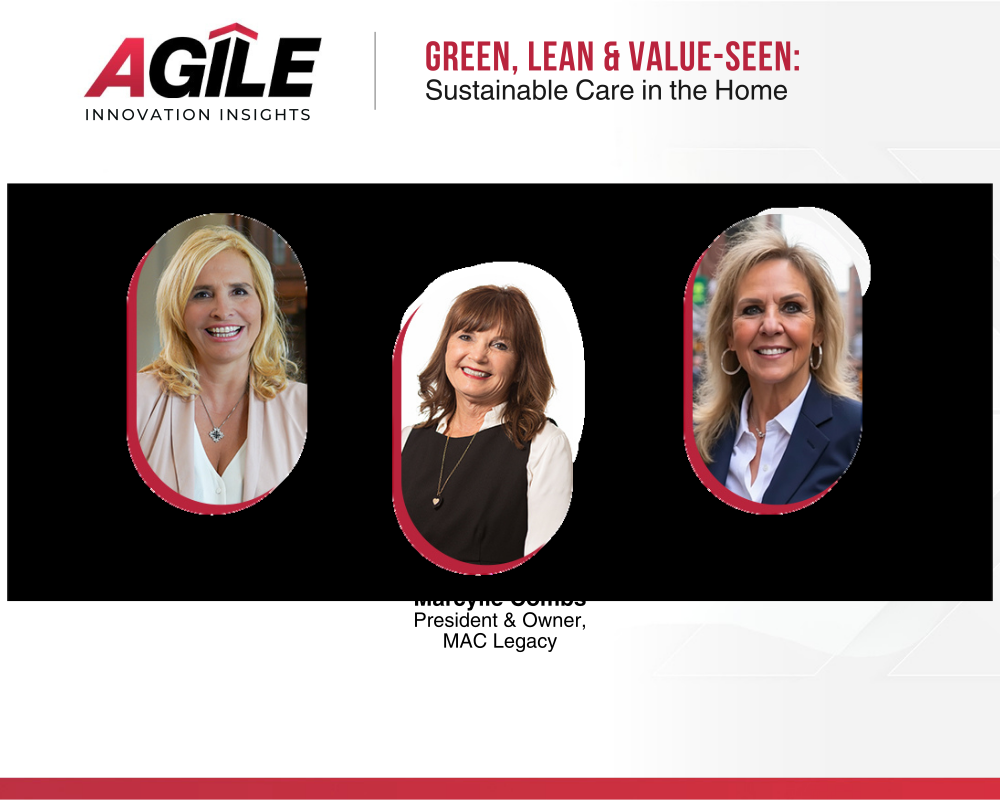
Green, Lean & Value-Seen session photo

Green, Lean & Value-Seen: Sustainable Care in the Home

Medicare Advantage performance issues rarely show up all at once—they surface across authorization delays, denial rates, hospitalizations and functional outcomes. Leaders often see these signals in isolation rather than as a connected risk profile. This insight delivers a unified, executive‑level view that allows organizations to identify where MA performance is drifting, prioritize intervention, and protect outcomes and financial stability.
Top Executive Insights
  • Expose Medicare Advantage risk before margins erode
Quick Wins
  • Revenue leakage indicators
  • Clinical exposure signals
  • Margin concentration risk
Industry Panel session photo

The Great AI Shift: How to Build (and Fly) the Plane in Midair

Neurocognitive diagnoses are among the most complex—and most scrutinized—areas in clinical documentation and coding. Small inconsistencies between documentation, diagnosis, and ICD-10 coding can create significant compliance, reimbursement, and audit exposure. This insight provides clear, practical guidance to help leaders and coding teams align documentation with appropriate diagnostic coding, ensuring accuracy, defensibility, and regulatory confidence.
Top Executive Insights
  • Improve neurocognitive coding accuracy to reduce audit risk
Quick Wins
  • Diagnosis coding mismatches across dementia, MCI, and related conditions
  • Improper sequencing or unspecified code usage increasing audit vulnerability
  • Documentation gaps that fail to support coded neurocognitive conditions

EDGE CERTIFICATION

Essential #1 Regulatory and Compliance

Many organizations manage compliance reactively—responding to audits, denials, or survey findings after risk has already materialized. As complexity increases across EVV, staffing, documentation, and billing, leaders need real-time visibility into the indicators most likely to trigger exposure. This insight introduces a practical, executive-visible Compliance Control Tower that consolidates high-risk metrics, enforces accountability, and turns compliance from firefighting into prevention.

Executive Action

Centralize compliance risk for proactive prevention.

Key Wins
Early audit and recoupment triggers (EVV failure rates, authorization vs. delivery variance)
Documentation and supervision breakdowns trending before claims impact
Operational compliance strain indicators such as overtime, missed visits, and credential lapses

Essential #2 Patient Centered Care

Age-Friendly Care efforts often stall after training—treated as a clinical initiative rather than an operational standard. When the 4Ms live only in care plans or education materials, their impact fades quickly. This insight helps leaders operationalize the 4Ms across intake, care planning, caregiver workflows, and quality review—so "What Matters," Medication, Mentation, and Mobility consistently shape decisions, actions, and outcomes every day.

Executive Action

Hardwire the 4Ms into daily care delivery.

Key Wins
Misalignment between stated goals and delivered care ("What Matters" gaps)
Medication and mobility risk signals missed between visits
Inconsistent caregiver reinforcement weakening continuity and outcomes

Essential #3 Innovation and AI

Many AI initiatives fail because organizations try to do too much at once—or pursue AI without a clear decision it is meant to improve. This insight helps leaders avoid "AI for AI's sake" by starting with one high-value predictive use case that directly changes behavior and outcomes. By clearly defining how leaders act on predictive insight—and setting guardrails that preserve human judgment—organizations can build confidence, prove value, and scale responsibly.

Executive Action

Focus AI on one decision, then expand.

Key Wins
Unanticipated risk signals (hospitalization, missed visits, or churn) identified before impact
Decision-action gaps where insight exists but workflows are undefined
False positive / false negative trends that require governance and tuning

Essential #4 Growth

Many organizations pursue growth by focusing on outcomes—revenue, referrals, or census—without aligning the daily behaviors that actually drive results. This often creates silos, inconsistent execution, and unpredictable performance. This insight provides leaders with a practical growth execution system built on lead measures, shared accountability, and weekly visibility—so growth becomes intentional, repeatable, and owned across the organization, not just by sales or leadership alone.

Executive Action

Discipline growth through shared leading-indicator accountability.

Key Wins
Lead measure gaps where activity does not support growth goals
Accountability breakdowns across sales, operations, and leadership
Conversion and Start of Care delays that stall referral momentum
Essential #1 Regulatory and Compliance

Many organizations manage compliance reactively—responding to audits, denials, or survey findings after risk has already materialized. As complexity increases across EVV, staffing, documentation, and billing, leaders need real-time visibility into the indicators most likely to trigger exposure. This insight introduces a practical, executive-visible Compliance Control Tower that consolidates high-risk metrics, enforces accountability, and turns compliance from firefighting into prevention.

Executive Action

Centralize compliance risk for proactive prevention.

Key Wins
Early audit and recoupment triggers (EVV failure rates, authorization vs. delivery variance)
Documentation and supervision breakdowns trending before claims impact
Operational compliance strain indicators such as overtime, missed visits, and credential lapses
Essential #2 Patient Centered Care

Age-Friendly Care efforts often stall after training—treated as a clinical initiative rather than an operational standard. When the 4Ms live only in care plans or education materials, their impact fades quickly. This insight helps leaders operationalize the 4Ms across intake, care planning, caregiver workflows, and quality review—so "What Matters," Medication, Mentation, and Mobility consistently shape decisions, actions, and outcomes every day.

Executive Action

Hardwire the 4Ms into daily care delivery.

Key Wins
Misalignment between stated goals and delivered care ("What Matters" gaps)
Medication and mobility risk signals missed between visits
Inconsistent caregiver reinforcement weakening continuity and outcomes
Essential #3 Innovation and AI

Many AI initiatives fail because organizations try to do too much at once—or pursue AI without a clear decision it is meant to improve. This insight helps leaders avoid "AI for AI's sake" by starting with one high-value predictive use case that directly changes behavior and outcomes. By clearly defining how leaders act on predictive insight—and setting guardrails that preserve human judgment—organizations can build confidence, prove value, and scale responsibly.

Executive Action

Focus AI on one decision, then expand.

Key Wins
Unanticipated risk signals (hospitalization, missed visits, or churn) identified before impact
Decision-action gaps where insight exists but workflows are undefined
False positive / false negative trends that require governance and tuning
Essential #4 Growth

Many organizations pursue growth by focusing on outcomes—revenue, referrals, or census—without aligning the daily behaviors that actually drive results. This often creates silos, inconsistent execution, and unpredictable performance. This insight provides leaders with a practical growth execution system built on lead measures, shared accountability, and weekly visibility—so growth becomes intentional, repeatable, and owned across the organization, not just by sales or leadership alone.

Executive Action

Discipline growth through shared leading-indicator accountability.

Key Wins
Lead measure gaps where activity does not support growth goals
Accountability breakdowns across sales, operations, and leadership
Conversion and Start of Care delays that stall referral momentum
Home Care

Education Sessions

High-Acuity Home Care session photo

High-Acuity Home Care: Where Clinical Excellence Meets Human Connection

When high-acuity clients aren't identified early, leaders spend more time reacting to crises than building sustainable systems. The result is a cycle where clinical risk and operational strain reinforce each other. Breaking this cycle requires connecting frontline clinical awareness with leadership discipline.
Top Executive Insights
  • Build early identification systems while strengthening leadership infrastructure to break the reactive cycle
Quick Wins
  • Late identification creating downstream crises
  • Caregiver-client mismatch straining operations
  • Leadership capacity consumed by preventable escalations
  • Process gaps blocking sustainable growth
Download Now: Break Down the Barriers
Multigenerational Speak, Teach, and Culture session photo

Multigenerational Speak, Teach, and Culture

Breakdowns in communication are often mislabeled as generational issues, when in reality they stem from mismatched preferences, unclear expectations, and inconsistent delivery. This insight helps leaders move beyond stereotypes and adopt a communication‑aware approach that improves coordination, education, and follow‑through across staff, caregivers, and patients. The result is fewer errors, reduced burnout, and stronger adherence—without adding complexity.
Top Executive Insights
  • Standardize communication clarity to reduce operational risk
Quick Wins
  • Communication breakdown frequency
  • Rework rates
  • Engagement gaps
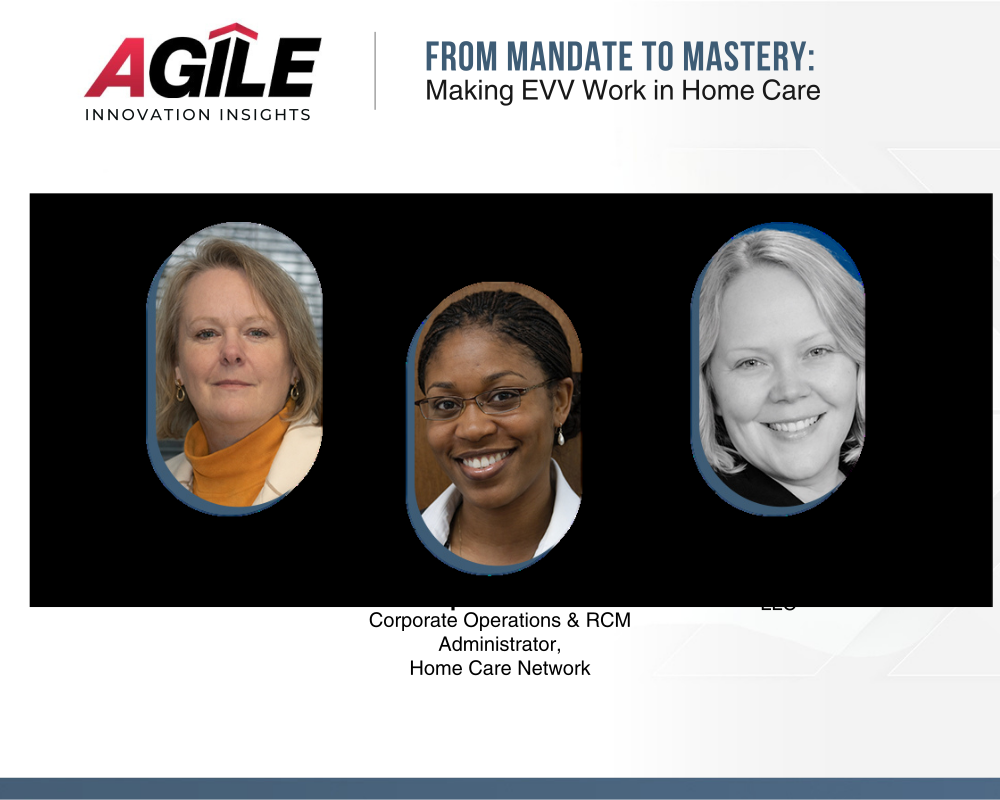
From Mandate to Mastery session photo

From Mandate to Mastery: Making EVV Work in Home Care

EVV challenges rarely stem from a single failure—they emerge from misalignment across systems, vendors, payers, and workflows. Many organizations treat EVV as a one‑time requirement rather than a continuous operational capability. This insight equips leaders with a practical framework to move EVV from reactive troubleshooting to predictable, compliant execution that safeguards revenue and reduces audit exposure.
Top Executive Insights
  • Stabilize EVV execution to protect compliance revenue
Quick Wins
  • EVV transmission failures
  • Vendor communication breakdowns
  • Denial trends
Leading Through the Noise session photo

Leading Through the Noise: Technology, AI, and the Reality of Care at Home

As technology stacks grow, complexity often outpaces value. Automation intended to save time can quietly introduce friction, duplication, and fatigue across intake, scheduling, EVV, billing, and documentation. This insight helps leaders step back and objectively assess whether their current tools are accelerating outcomes—or creating drag—and provides a structured approach to making clearer, more defensible technology decisions.
Top Executive Insights
  • Reduce friction by redesigning technology around workflows
Quick Wins
  • Workflow friction indicators
  • Redundant systems
  • Margin impact

EDGE CERTIFICATION

Essential #1 Regulatory and Compliance

Regulatory and compliance risk in hospice manifests through two interconnected pathways: billing exposure and survey vulnerability. Billing risk accumulates through small inconsistencies across eligibility and documentation, while survey deficiencies reflect systemic operational breakdowns. When these risks are managed in silos, organizations often address symptoms rather than root causes—leaving both revenue and licensure exposed.

Executive Action

Establish unified compliance oversight that connects billing discipline to survey readiness, ensuring daily claims validation and operational rigor reinforce each other.

Key Wins
Eligibility and documentation gaps creating billing exposure
Level-of-care mismatches and NOE timing errors
Plan-of-care gaps and documentation drift
Supervision failures and systemic operational breakdowns

Essential #2 Patient Centered Care

CAHPS results don't reflect isolated moments—they reflect consistent behaviors families experience across communication, responsiveness, symptom management, emotional support, and respect. Many leaders focus on scores after they're published, without fully understanding how day to day workflows map directly to the questions families are answering. This insight breaks down the Hospice CAHPS survey itself, helping leaders translate survey language into concrete operational and clinical behaviors that drive better experience, stronger ratings, and fewer surprises.

Executive Action

Design care experiences around CAHPS expectations.

Key Wins
Responsiveness and after hours support gaps drive low CAHPS responses
Communication consistency failures across explanation, updates, and listening
Symptom management breakdowns (pain, breathing, anxiety) visible through family feedback

Essential #3 Innovation and AI

Many AI missteps occur not because the technology is flawed, but because instructions are unclear, incomplete, or lack guardrails. When prompts fail to define role, intent, constraints, or output expectations, AI responses can introduce risk, noise, or rework. This insight reframes AI as a support resource that must be directed with the same clarity as any team member—helping organizations reduce documentation burden, maintain regulatory confidence, and trust the outputs they receive.

Executive Action

Standardize how AI is prompted across the organization to ensure outputs are clear, compliant, clinically appropriate, and aligned with professional judgment.

Key Wins
Clear role definition so AI responds from an appropriate clinical, operational, or leadership perspective
Improved output consistency through explicit formatting and length expectations
Reduced rework and risk by embedding constraints that preserve accuracy and compliance

Essential #4 Growth

Hospice quality performance is no longer evaluated through a single lens. The Hospice Quality Reporting Program (HQRP) combines CAHPS experience measures, claims-based utilization data, and clinical follow-up metrics—each telling part of the story regulators, payers, and the public are evaluating. Many organizations review these measures in isolation or after results are published. This insight helps leaders understand how HQRP measures work together and how to operationalize them proactively—so quality performance is designed, monitored, and adjusted in real time, not explained after the fact.

Executive Action

Manage quality as a system, not scores.

Key Wins
CAHPS experience drivers (communication, responsiveness, symptom management) impacting 50% of star ratings
Claims-based quality risk signals such as visits near death, live discharges, and burdensome transitions
Timeliness gaps in symptom follow-up for pain and non-pain measures under HOPE
Essential #1 Regulatory and Compliance

Regulatory and compliance risk in hospice manifests through two interconnected pathways: billing exposure and survey vulnerability. Billing risk accumulates through small inconsistencies across eligibility and documentation, while survey deficiencies reflect systemic operational breakdowns. When these risks are managed in silos, organizations often address symptoms rather than root causes—leaving both revenue and licensure exposed.

Executive Action

Establish unified compliance oversight that connects billing discipline to survey readiness, ensuring daily claims validation and operational rigor reinforce each other.

Key Wins
Eligibility and documentation gaps creating billing exposure
Level-of-care mismatches and NOE timing errors
Plan-of-care gaps and documentation drift
Supervision failures and systemic operational breakdowns
Essential #2 Patient Centered Care

CAHPS results don't reflect isolated moments—they reflect consistent behaviors families experience across communication, responsiveness, symptom management, emotional support, and respect. Many leaders focus on scores after they're published, without fully understanding how day to day workflows map directly to the questions families are answering. This insight breaks down the Hospice CAHPS survey itself, helping leaders translate survey language into concrete operational and clinical behaviors that drive better experience, stronger ratings, and fewer surprises.

Executive Action

Design care experiences around CAHPS expectations.

Key Wins
Responsiveness and after hours support gaps drive low CAHPS responses
Communication consistency failures across explanation, updates, and listening
Symptom management breakdowns (pain, breathing, anxiety) visible through family feedback
Essential #3 Innovation and AI

Many AI missteps occur not because the technology is flawed, but because instructions are unclear, incomplete, or lack guardrails. When prompts fail to define role, intent, constraints, or output expectations, AI responses can introduce risk, noise, or rework. This insight reframes AI as a support resource that must be directed with the same clarity as any team member—helping organizations reduce documentation burden, maintain regulatory confidence, and trust the outputs they receive.

Executive Action

Standardize how AI is prompted across the organization to ensure outputs are clear, compliant, clinically appropriate, and aligned with professional judgment.

Key Wins
Clear role definition so AI responds from an appropriate clinical, operational, or leadership perspective
Improved output consistency through explicit formatting and length expectations
Reduced rework and risk by embedding constraints that preserve accuracy and compliance
Essential #4 Growth

Hospice quality performance is no longer evaluated through a single lens. The Hospice Quality Reporting Program (HQRP) combines CAHPS experience measures, claims-based utilization data, and clinical follow-up metrics—each telling part of the story regulators, payers, and the public are evaluating. Many organizations review these measures in isolation or after results are published. This insight helps leaders understand how HQRP measures work together and how to operationalize them proactively—so quality performance is designed, monitored, and adjusted in real time, not explained after the fact.

Executive Action

Manage quality as a system, not scores.

Key Wins
CAHPS experience drivers (communication, responsiveness, symptom management) impacting 50% of star ratings
Claims-based quality risk signals such as visits near death, live discharges, and burdensome transitions
Timeliness gaps in symptom follow-up for pain and non-pain measures under HOPE
Hospice

Education Sessions

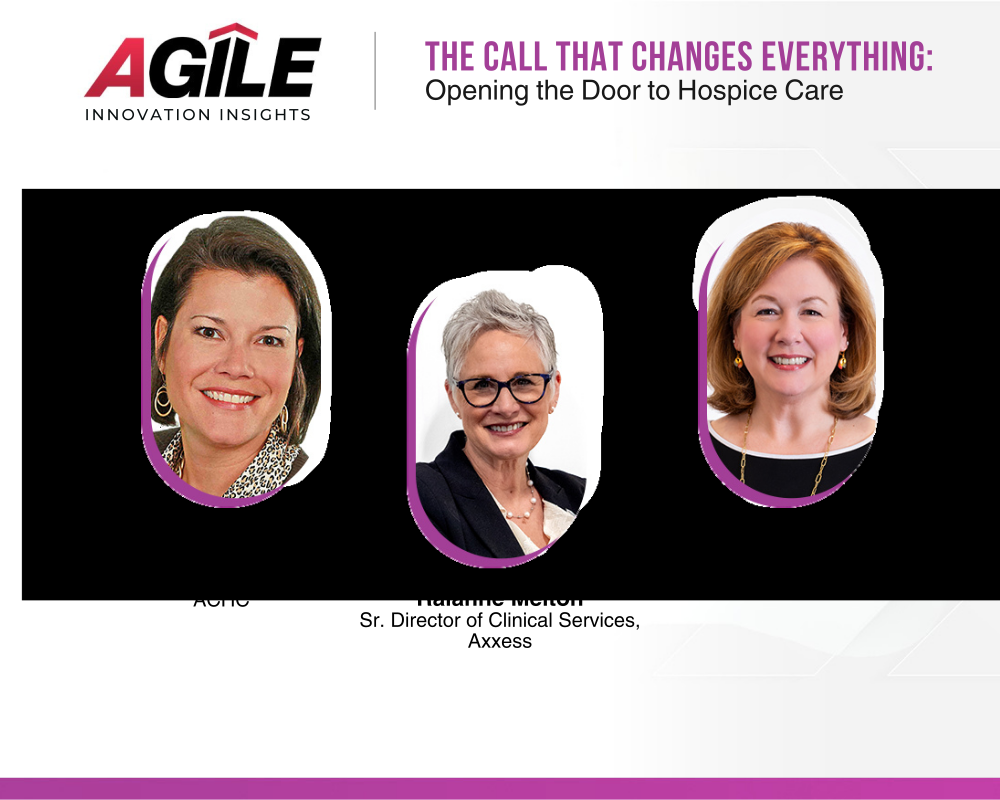
The Call That Changes Everything session photo

The Call That Changes Everything: Opening the Door to Hospice Care

Hospice referrals are often delayed—not because clinicians lack compassion or expertise, but because early indicators are missed or difficult to standardize. This insight provides a clear, trigger‑based framework that helps care teams recognize clinical, functional, and readiness signals sooner. By operationalizing early identification, leaders can support more informed conversations, improve patient experience, and ensure care aligns with goals rather than crisis.
Top Executive Insights
  • Identify hospice need earlier to guide timely care
Quick Wins
  • Late referrals
  • Missed decline signals
  • Goals-of-care gaps
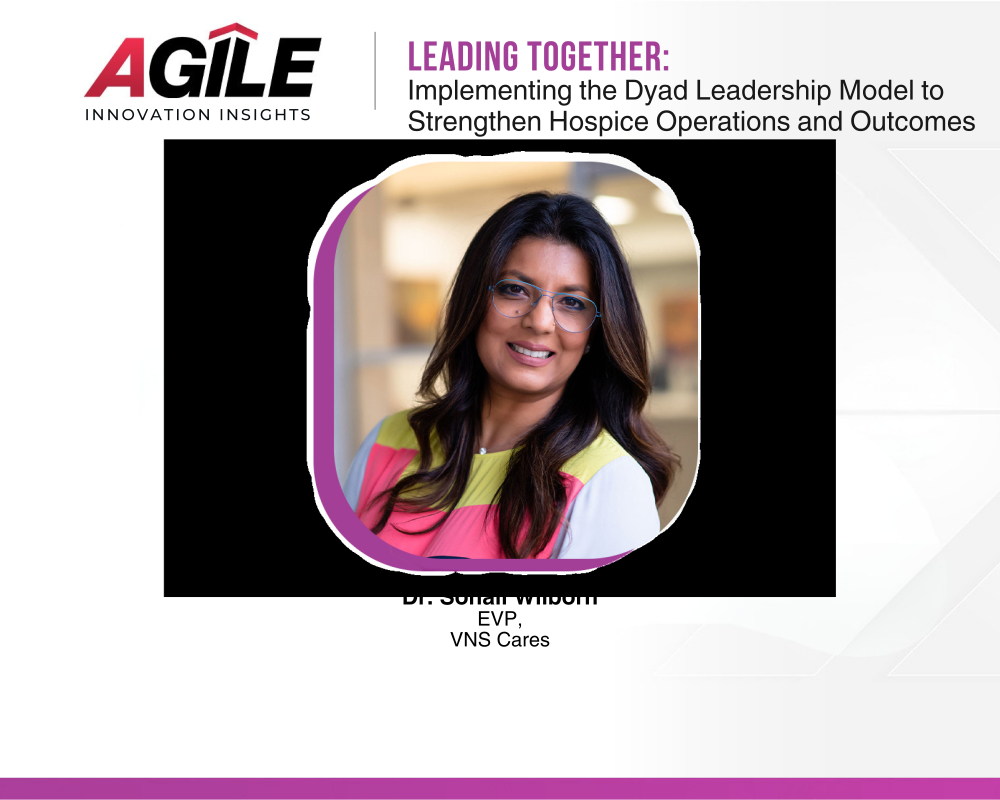
Leading Together session photo

Leading Together: Implementing the Dyad Leadership Model to Strengthen Hospice Operations and Outcomes

Organizations often adopt the dyad model with good intent but unclear execution—introducing shared leadership before roles, decision rights, and operating rhythms are defined. This insight provides a practical, phased approach to building dyad partnerships intentionally, reducing friction, confusion, and power struggles early. When done well, dyads accelerate alignment, trust, and results rather than slowing decisions or creating parallel leadership tracks.
Top Executive Insights
  • Stabilize clinical-operational partnerships before scaling
Quick Wins
  • Role clarity breakdowns
  • Decision delays
  • Early dyad imbalance
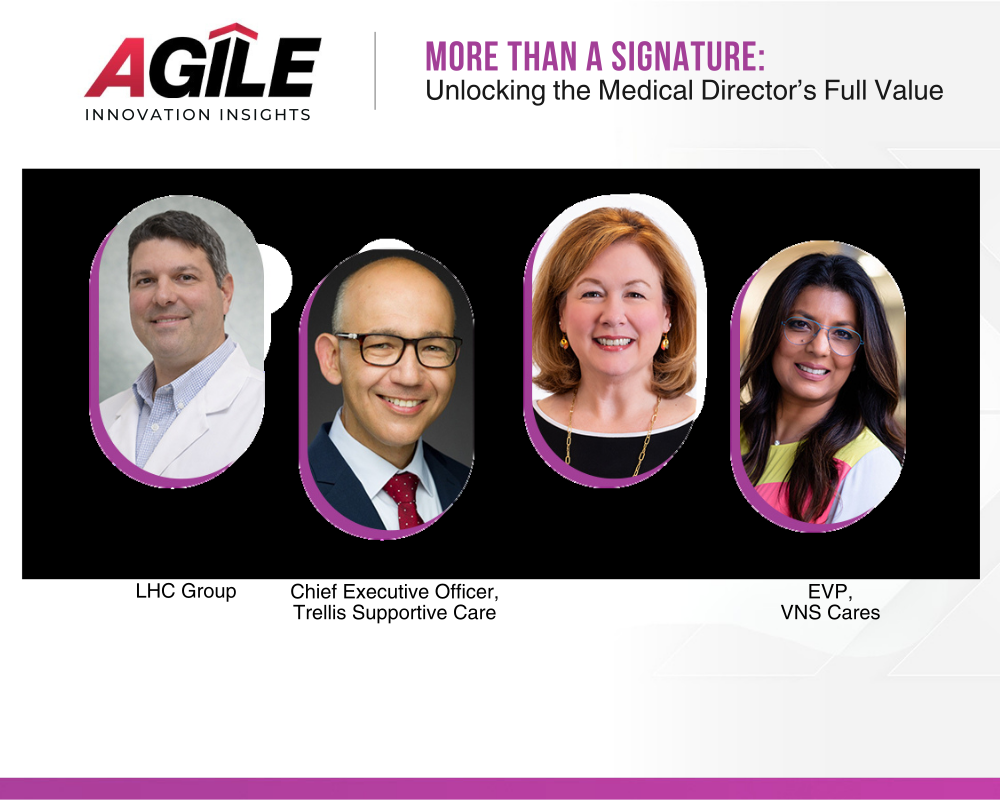
More Than a Signature session photo

More Than a Signature: Unlocking the Medical Director's Full Value

Medical directors are often underutilized—engaged just enough to meet regulatory minimums, but not positioned as the strategic clinical partners they are intended to be. This insight helps organizations clearly define expectations, deepen engagement, and operationalize the medical director’s role across quality, compliance, documentation, and interdisciplinary collaboration. When engaged intentionally, medical directors strengthen defensibility, elevate care quality, and reduce organizational risk.
Top Executive Insights
  • Activate medical directors as strategic clinical leaders
Quick Wins
  • Engagement gaps
  • Documentation risk
  • Survey exposure
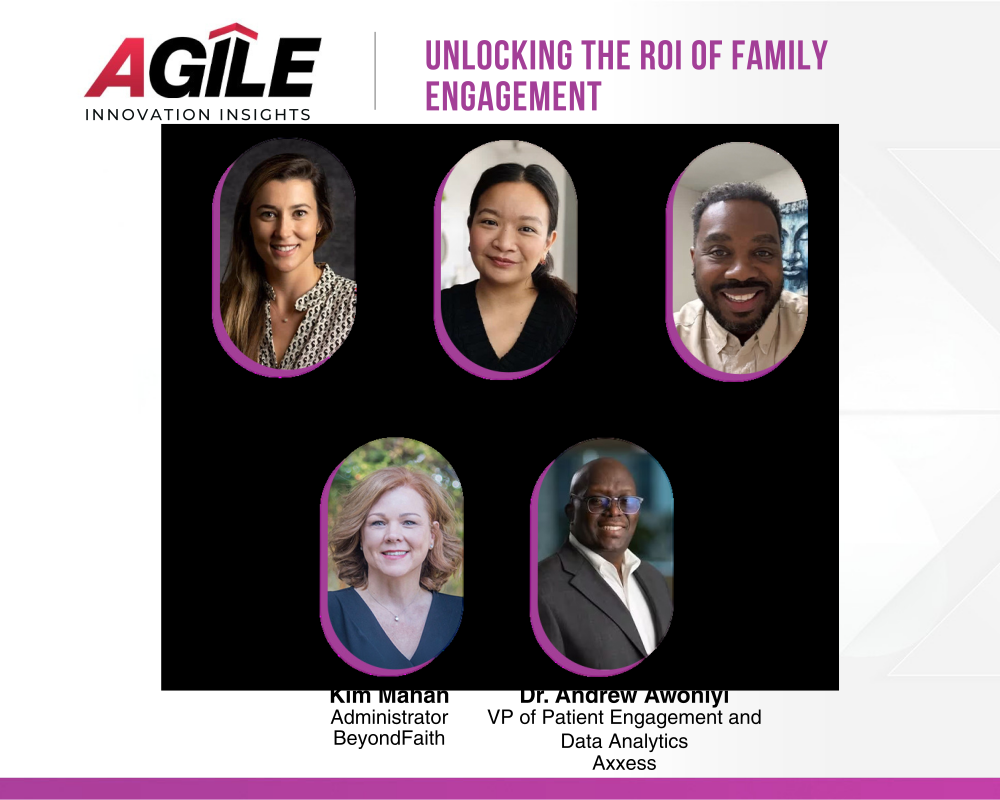
Unlocking the ROI of Family Engagement session photo

Unlocking the ROI of Family Engagement

Family experience is often addressed reactively—measured after discharge or surfaced through complaints—rather than designed intentionally across the care journey. This insight enables leaders to evaluate whether caregiver support, communication, feedback, and insights are truly systematic or still ad‑hoc. By operationalizing family experience, organizations can strengthen trust, improve adherence, protect CAHPS performance, and reduce downstream dissatisfaction before it escalates into risk.
Top Executive Insights
  • Operationalize family engagement to reduce experience risk
Quick Wins
  • Communication gaps
  • Feedback blind spots
  • Early dissatisfaction signals
Presented by